The Most Common PLC Failure That Isn’t Technical
In many factories, PLC failures are discussed as technical events. Engineers focus on hardware condition, firmware versions, communication stability, or electrical environment. These are real and important factors.
Yet across different industries, plant sizes, and automation platforms, one pattern appears repeatedly.
Systems stop not because equipment is impossible to repair, but because no one fully understands them anymore.
The controller may still be functional. Replacement parts may be available. The logic may be recoverable. But the knowledge required to act quickly has faded—sometimes slowly, sometimes suddenly.
When this happens, downtime is no longer a technical problem.
It becomes an organizational one.
How Knowledge Quietly Disappears from Automation Systems
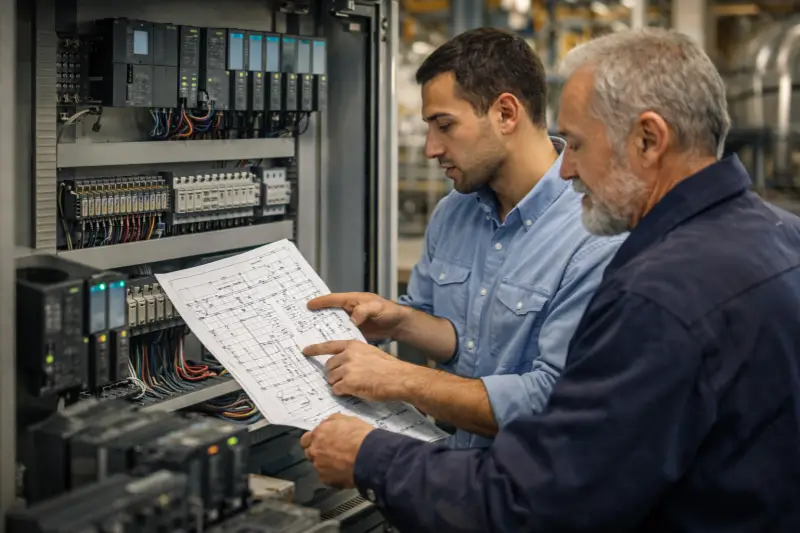
Loss of institutional knowledge rarely happens in a dramatic way. It accumulates over years of normal change.
Senior engineers retire. Contractors complete projects and move on. Maintenance teams rotate roles. Documentation written during commissioning is never updated to reflect later modifications. Small logic changes are made during night shifts and never formally recorded.
At first, none of this seems dangerous. The system continues running, and production targets are met.
But the understanding of why the system behaves the way it does gradually becomes fragmented across individuals rather than preserved in records.
Eventually, the plant is left operating complex automation with only partial visibility into its own control logic and architecture.
Why New Hardware Cannot Replace Lost Understanding
When uncertainty grows, organizations often respond by upgrading hardware. New PLCs, new HMIs, and new communication modules create a sense of progress and control.
But hardware replacement does not restore missing knowledge.
Without clear documentation, engineers hesitate to make changes. Troubleshooting takes longer because root causes are unclear. Recovery decisions feel risky because no one is certain how the system will respond.
In these situations, downtime expands not because problems are technically difficult, but because confidence is missing.
Documentation as a Reliability Infrastructure
In well-managed automation environments, documentation is treated as part of the system itself rather than an afterthought.
Accurate network diagrams, firmware baselines, spare-part mappings, I/O allocation tables, and recovery procedures create a shared understanding that survives personnel changes.
When failures occur, engineers do not start from zero. They follow a known path.
This dramatically shortens mean time to repair and reduces operational stress during downtime events.
Documentation, in this sense, is not paperwork.
It is reliability infrastructure.
The Relationship Between Documentation and Spare Parts Strategy
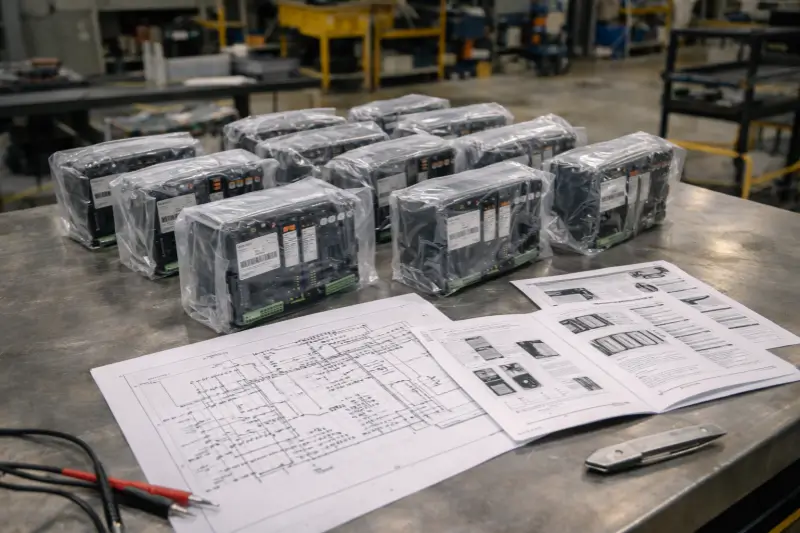
Clear documentation directly influences spare parts planning.
When teams understand which modules are critical, which are interchangeable, and which are approaching obsolescence, inventory decisions become strategic rather than reactive.
Instead of emergency sourcing during failures, facilities maintain targeted readiness.
For widely deployed control platforms, maintaining visibility into verified replacement inventory supports documented recovery strategies and reduces uncertainty during outages
https://topautodevice.com/collections/allen-bradley
Tribal Knowledge vs Transferable Knowledge
Many plants rely heavily on experienced individuals who “just know” how systems work. This tribal knowledge is valuable, but fragile.
It cannot scale, cannot be audited, and cannot survive turnover.
Transferable knowledge—captured through structured documentation and repeatable procedures—creates resilience. It allows new engineers to act with confidence and ensures that system behavior remains understandable years after commissioning.
Organizations that transition from tribal knowledge to transferable knowledge consistently experience faster recovery and more stable operations.
Why Poor Documentation Increases Safety and Compliance Risk
Incomplete knowledge affects more than uptime. It also affects safety.
Unclear logic behavior, undocumented bypasses, and unknown firmware changes create environments where safety response cannot be fully predicted. During audits or incident investigations, missing documentation often becomes a primary concern.
Regulatory expectations increasingly require traceability and procedural clarity. Facilities without reliable records face both operational and compliance exposure.
In this way, documentation supports not only maintenance, but governance.
Knowledge Loss During Modernization Projects
Modernization projects are often seen as opportunities to reset documentation. In practice, they sometimes accelerate knowledge loss.
Legacy systems are replaced quickly to meet schedules. Old logic is converted rather than fully analyzed. Historical design intent is forgotten once new hardware is operational.
Without deliberate effort, modernization can exchange known complexity for unknown complexity.
True modernization preserves understanding while updating technology.
Institutional Knowledge and Multi-Warehouse Recovery
In distributed supply environments, institutional knowledge determines whether multi-warehouse fulfillment improves resilience or introduces confusion.
When recovery procedures are documented, parts sourced from different regions can be installed confidently. Firmware compatibility, wiring expectations, and configuration steps are already known.
Without documentation, global inventory does not reduce downtime.
It simply spreads uncertainty across locations.
Maintaining centralized visibility into available automation components supports documented recovery planning and aligns supply with operational readiness.
The Human Side of Automation Reliability
Automation is often described in technical language—controllers, networks, protocols, redundancy. Yet long-term reliability depends equally on human continuity.
Teams that communicate clearly, record decisions, and preserve lessons learned create systems that remain stable beyond individual careers.
Teams that rely solely on memory eventually face moments where no one remembers enough to act quickly.
At that point, downtime becomes inevitable.
Building a Culture That Preserves Knowledge
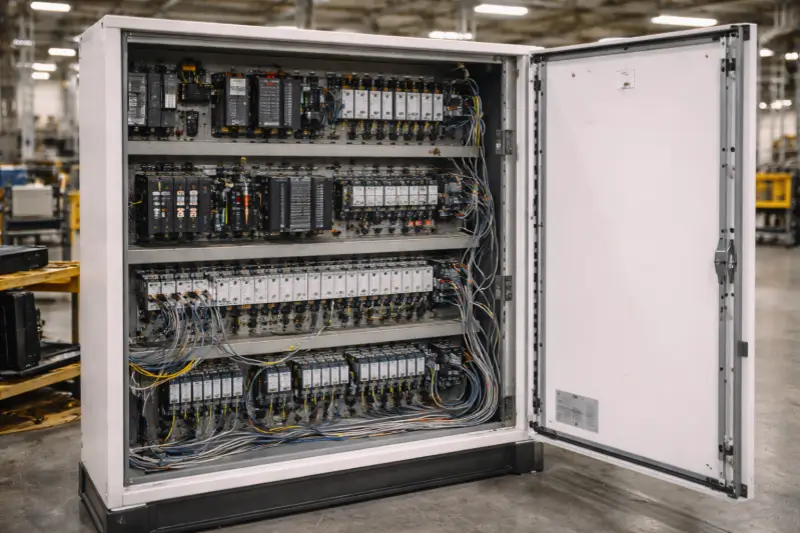
Preserving institutional knowledge is not a single project. It is a cultural practice.
Organizations that succeed typically share several behaviors. Documentation is updated after changes, not postponed. Recovery procedures are tested, not assumed. Knowledge transfer is planned before retirements or transitions occur.
These habits appear small, but their cumulative effect is significant.
They transform fragile automation into durable infrastructure.
Why Knowledge Continuity Extends Hardware Lifespan
Well-documented systems often remain operational far longer than expected.
Engineers can safely maintain legacy equipment, plan phased upgrades, and avoid unnecessary replacements because system behavior is understood.
This reduces capital expenditure and stabilizes production planning.
In contrast, poorly documented systems are often replaced prematurely—not because they are obsolete, but because they are no longer trusted.
Reliability Is Remembered, Not Installed
New PLC hardware can improve performance. Clean power can stabilize operation. Verified spare parts can shorten recovery.
But none of these matter if the system itself is no longer understood.
Long-term reliability is built on remembered knowledge—captured, shared, and preserved across time.
Factories that protect institutional knowledge protect uptime itself.