PLC Failures Often Begin Outside the Controller
When engineers investigate PLC failures, attention naturally focuses on the controller itself. Diagnostics, firmware, communication, and power quality are all valid areas to examine.
Yet in many real-world environments, the earliest damage to automation hardware begins somewhere else entirely.
It begins inside the control cabinet.
Temperature, airflow, enclosure layout, and heat dissipation determine whether electronic components operate within safe limits or slowly degrade over time. Because thermal stress accumulates gradually, it rarely appears in early troubleshooting. By the time visible faults occur, the underlying cause has often existed for years.
This is why two identical PLC systems installed in different cabinets can experience dramatically different lifespans.
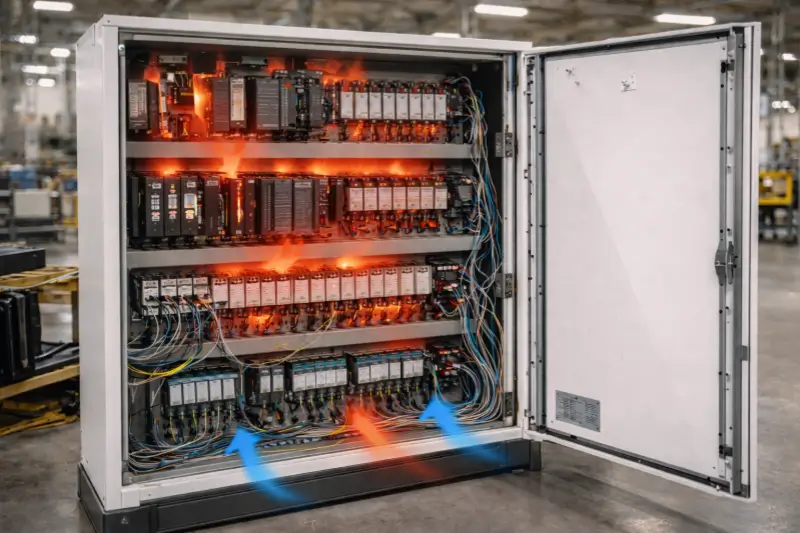
Heat: The Invisible Enemy of Industrial Electronics
Electronic components are highly sensitive to temperature. Even small increases above recommended operating ranges accelerate aging of capacitors, power regulators, and communication circuitry.
Unlike sudden electrical failures, thermal damage is cumulative. Systems may run normally for long periods before instability appears. Communication errors, unexpected resets, and shortened component life frequently trace back to prolonged heat exposure rather than manufacturing defects.
In tightly packed cabinets without proper airflow, internal temperatures can exceed ambient factory conditions by a significant margin. Engineers sometimes underestimate this difference because cabinet interiors are rarely monitored continuously.
Over time, heat becomes one of the most reliable predictors of premature PLC failure.
Why Cabinet Layout Matters More Than Many Engineers Expect
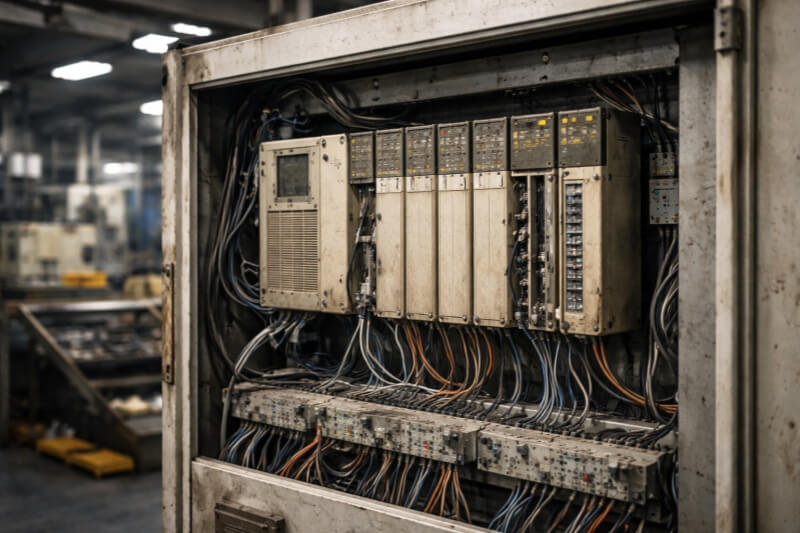
Control cabinet design is often constrained by space, legacy wiring, or installation convenience. Components are arranged to fit rather than to breathe.
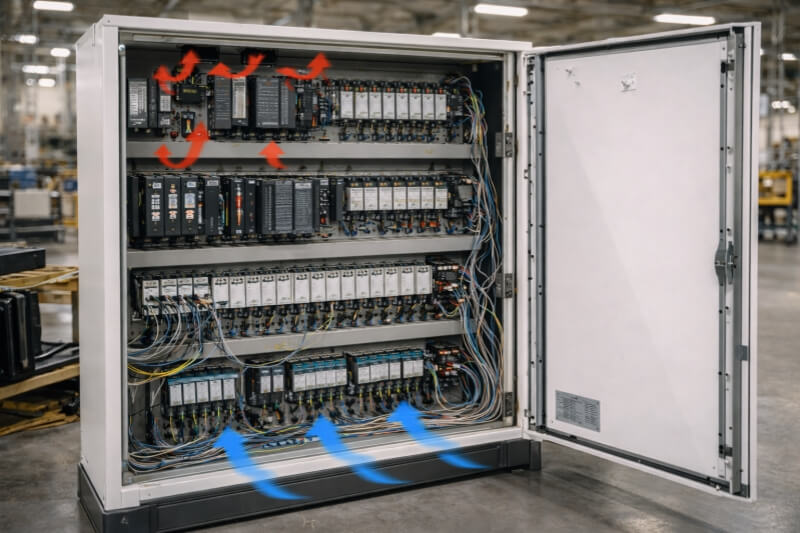
Poor layout creates thermal pockets where heat cannot escape. Power supplies and drives generate localized temperature rise that spreads to nearby PLC modules. Without separation or airflow planning, sensitive electronics absorb this heat continuously.
Well-designed cabinets treat airflow as an engineered path rather than an accident. Component spacing, vertical heat movement, and ventilation placement all influence long-term stability.
These decisions are made once during installation but affect reliability for decades.
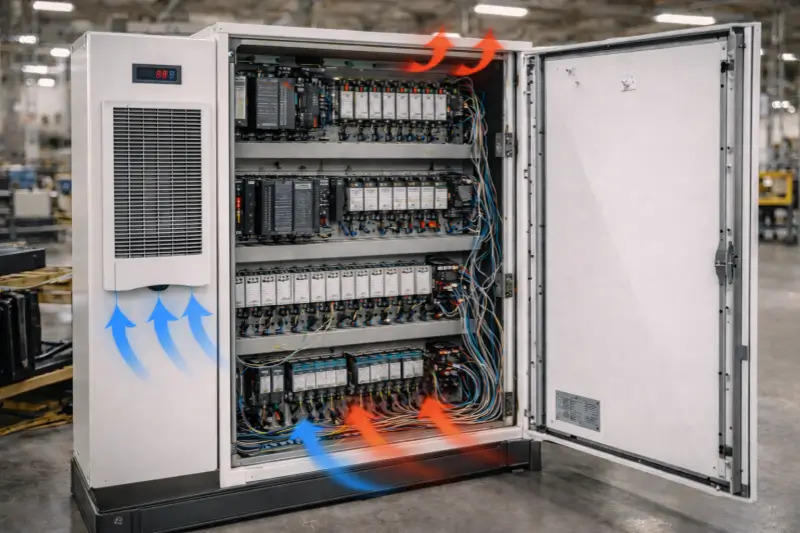
Cooling Strategies and Their Operational Trade-Offs
Industrial cabinets use several cooling approaches, each with advantages and risks.
Passive ventilation is simple and low maintenance but depends heavily on ambient conditions. Forced-air fans improve circulation yet introduce dust and require maintenance. Closed-loop air conditioners provide stable temperatures but increase cost and complexity.
The correct solution depends on environment, heat load, and reliability requirements. Problems arise when cooling strategy is chosen based only on installation cost rather than lifecycle stability.
Facilities that evaluate thermal management as part of uptime planning consistently experience fewer unexplained failures.
Thermal Stress and Intermittent PLC Behavior
Heat rarely causes immediate shutdown. Instead, it changes electrical characteristics subtly.
Signal timing drifts. Communication retries increase. Internal regulators operate closer to limits. Under specific load or ambient conditions, the PLC resets or faults without clear explanation.
Because symptoms are inconsistent, engineers often suspect firmware or network problems. Replacing modules temporarily improves behavior, but the underlying heat source remains.
Eventually, the pattern repeats.
Understanding thermal influence transforms troubleshooting from guesswork into diagnosis.
Control Cabinets as Reliability Infrastructure
A control cabinet is more than a housing. It is an environmental control system for electronics.
Well-engineered enclosures stabilize temperature, reduce contamination, manage airflow, and protect wiring integrity. Poorly designed cabinets accelerate aging and increase maintenance frequency.
Seen from this perspective, enclosure design becomes part of automation architecture rather than mechanical detail.
Organizations that invest in proper cabinet engineering effectively extend the lifespan of every PLC installed within them.
Thermal Management and Spare Parts Consumption
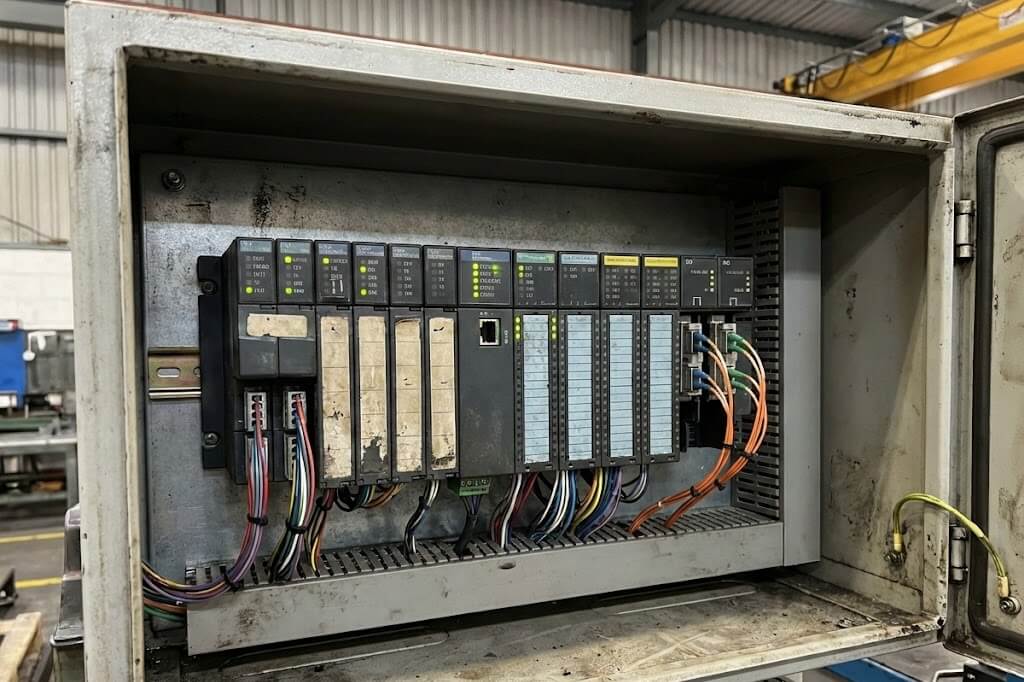
Facilities with poor thermal conditions consume spare parts faster. Modules fail earlier, replacements are installed more often, and maintenance budgets rise.
Conversely, stable thermal environments reduce failure frequency and allow predictable replacement planning.
When failures do occur, access to verified replacement PLC components across multiple regions ensures rapid recovery and minimizes production impact
https://topautodevice.com/pages/shop-by-brands
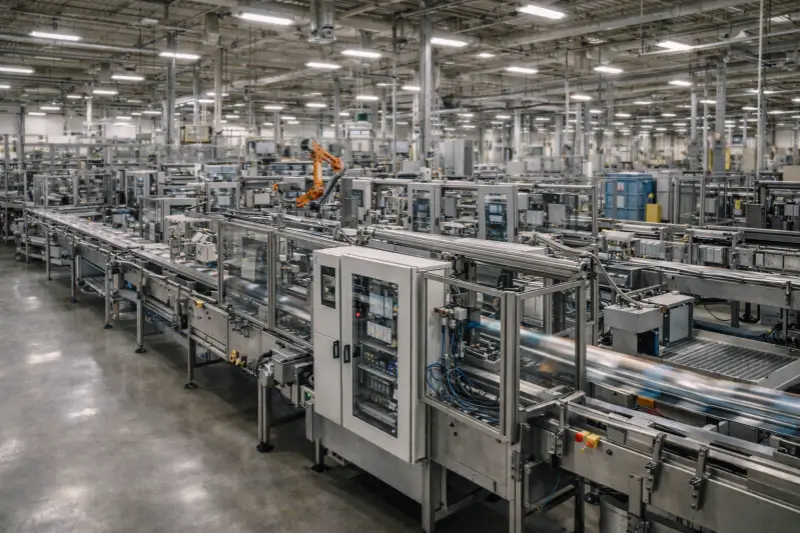
Planning Cabinets for Long-Term Automation Evolution
Automation systems rarely remain static. I/O expands, communication modules are added, and power demand increases. Cabinets originally designed for smaller loads become thermally stressed.
Future-ready cabinet design anticipates expansion. Extra airflow capacity, reserved space, and scalable cooling prevent reliability decline as systems evolve.
Planning for change at the enclosure level protects long-term uptime more effectively than repeated hardware replacement.
Final Thoughts
PLC reliability is deeply connected to the environment surrounding the controller. Temperature control, airflow planning, and enclosure engineering quietly determine whether automation systems operate for years or fail prematurely.
In industrial automation, longevity is not only designed in software or firmware.
It is built into the cabinet itself.