Why Counterfeit PLC Spare Parts Are a Growing Problem in 2026
The global demand for industrial automation spare parts continues to rise. Aging equipment, longer system lifecycles, and unpredictable OEM lead times have pushed many factories to look beyond traditional procurement channels.
At the same time, the global spare parts market has changed.
Counterfeit PLC spare parts are no longer crude copies with obvious defects. In 2026, counterfeit hardware often looks identical to genuine products on the surface. Labels, packaging, serial numbers, and even documentation may appear legitimate.
The real danger is not visual.
It is invisible.
Firmware integrity, internal component quality, and undocumented modifications introduce risks that many plants do not discover until failure occurs.
In critical automation environments, counterfeit PLC parts do not just fail. They create unpredictable behavior, safety exposure, and OT security vulnerabilities.
What “Counterfeit” Really Means in Industrial Automation
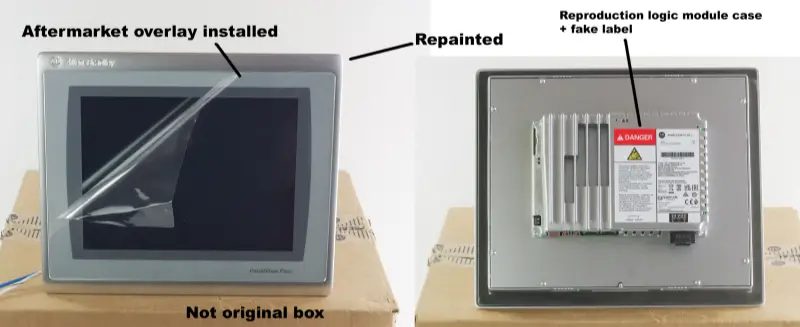
In industrial automation, counterfeit does not always mean “fake.”
There are several high-risk categories commonly encountered in the spare parts market.
The first is fully counterfeit hardware. These units are manufactured without authorization and often use lower-grade components, cloned PCBs, and unverified firmware.
The second is refurbished hardware sold as new. Used or repaired PLC modules are cleaned, re-labeled, and packaged as factory-sealed units. Internal wear, component fatigue, and unknown failure history remain hidden.
The third is hardware modified after leaving the factory. This includes firmware alteration, component replacement, or unauthorized rework that changes behavior under load.
The fourth is gray-market diversion. Genuine parts are sourced outside authorized channels, often without traceable history, environmental controls, or firmware integrity guarantees.
From the outside, all of these can appear legitimate.
From the inside, they introduce serious operational risk.
Why Counterfeit PLC Parts Are Hard to Detect
Modern PLC hardware is compact, sealed, and firmware-driven. Visual inspection is no longer sufficient.
Most counterfeit or compromised modules pass the following checks:
-
Correct label and logo
-
Matching part number
-
Authentic-looking packaging
-
Acceptable boot behavior
-
Initial communication success
Problems often appear later, under load, during network stress, or after firmware interaction.
This delay is what makes counterfeit PLC parts so dangerous. Failure is not immediate. It is intermittent, irregular, and difficult to diagnose.
Firmware Integrity: The Most Overlooked Risk
Firmware is the brain of a PLC.
Even genuine hardware becomes unsafe if firmware is altered, mismatched, or corrupted.
Counterfeit or compromised spare parts frequently introduce firmware-related risks, including:
-
Modified bootloaders
-
Incomplete firmware images
-
Version mismatch with existing I/O
-
Disabled safety features
-
Undocumented behavior under fault conditions
In ControlLogix and CompactLogix systems, firmware compatibility is not optional. A single mismatch can destabilize the entire rack.
Unlike software environments, firmware errors in PLCs cannot always be rolled back safely during operation.
Firmware Mismatch and Downtime Escalation
A common real-world scenario looks like this.
A CPU fails. A replacement is sourced urgently. The hardware boots, but I/O faults appear. Communication becomes unstable. Motion control behaves unpredictably. The line stops again.
The issue is not the hardware.
It is firmware incompatibility.
In counterfeit or gray-market parts, firmware history is often unknown. Even if the module appears functional, its internal firmware may differ subtly from expectations.
Downtime increases, not decreases.
Safety System Exposure from Counterfeit Parts
Safety PLCs, GuardLogix controllers, safety I/O, and safety relays rely on deterministic behavior.
Counterfeit or modified hardware undermines this determinism.
Risks include:
-
Delayed safety response
-
Incorrect diagnostic reporting
-
Failure to enter safe state
-
Inconsistent reaction to fault conditions
In regulated environments, this creates compliance risk. In physical environments, it creates real danger to personnel.
Safety systems must behave exactly as designed. Any deviation introduces unacceptable uncertainty.
Counterfeit Parts as an OT Security Attack Surface
OT security discussions often focus on networks, firewalls, and protocols. Hardware supply chains receive far less attention.
This is a mistake.
Counterfeit or compromised PLC hardware introduces a physical attack vector into otherwise secure networks.
Potential risks include:
-
Backdoored firmware
-
Undocumented network behavior
-
Modified communication stacks
-
Inability to verify firmware integrity
-
Inconsistent response to security monitoring tools
In 2026, OT security standards increasingly emphasize internal monitoring and asset trust. Hardware of unknown origin undermines these efforts.
Security cannot be layered on top of untrusted components.
Why OEM Supply Shortages Increase Counterfeit Risk
Counterfeit markets expand when demand exceeds supply.
OEM lead times, EOL transitions, and final-run shortages create exactly this condition.
When factories face long delays, emergency sourcing pressure rises. Procurement decisions are made faster. Verification steps are skipped.
Counterfeit sellers exploit this urgency.
The more critical the failure, the higher the risk of accepting compromised hardware.
The True Cost of “Cheaper” Spare Parts
Counterfeit or gray-market parts often appear cheaper upfront.
The real cost emerges later.
Costs include:
-
Extended downtime due to unstable behavior
-
Repeat failures
-
Engineering time spent diagnosing invisible issues
-
Emergency replacement of the replacement
-
Safety audits and compliance exposure
-
OT security incident investigation
-
Loss of trust in spare parts inventory
In many cases, one counterfeit failure costs more than years of proper sourcing.
How Professional MRO Teams Reduce Counterfeit Risk
Experienced maintenance organizations follow disciplined sourcing practices.
They prioritize traceability over price, consistency over convenience, and recovery certainty over theoretical savings.
Key practices include:
-
Working with suppliers who provide verifiable sourcing
-
Avoiding unknown secondary marketplaces
-
Requiring documented inventory handling
-
Maintaining firmware discipline
-
Using replacement instead of repair for critical components
-
Building relationships with trusted suppliers
Why Traceability Matters More Than Labels
Labels can be copied. Serial numbers can be cloned.
Traceability means understanding where a part came from, how it was stored, how it was handled, and how it was verified.
Trusted suppliers maintain:
-
Controlled inventory environments
-
Batch-level tracking
-
Clear sourcing documentation
-
Defined handling processes
-
Replacement guarantees rather than repair uncertainty
This is what separates professional supply from opportunistic reselling.
The Role of Replacement Guarantees in Risk Reduction
Repair introduces uncertainty.
Repaired parts carry unknown stress history, component degradation, and variable quality.
Replacement-based supply models eliminate much of this uncertainty.
Suppliers that support multi-year replacement warranties provide confidence that failures will not escalate into prolonged downtime.
This approach aligns with modern zero-downtime strategies.
Multi-Warehouse Supply as a Trust Signal
Speed and trust are connected.
Suppliers with geographically distributed inventory reduce pressure during failures. When recovery can happen within days instead of weeks, procurement decisions remain rational.
Multi-warehouse supply models reduce the temptation to source from unknown or high-risk channels during emergencies.
Suppliers maintaining inventory across regions such as the United States, Shenzhen, and Jiangsu provide both speed and redundancy.
This structure supports safe decision-making under pressure.
How to Identify High-Risk Spare Parts Scenarios
Certain situations dramatically increase counterfeit risk.
These include:
-
Emergency sourcing during active downtime
-
Obsolete or EOL hardware
-
Firmware-locked modules
-
Safety-related components
-
Network communication modules
-
Parts with unusually low pricing
-
Sellers unwilling to discuss sourcing
Recognizing these scenarios helps teams pause and verify rather than react blindly.
A Practical Checklist for Safe PLC Spare Parts Sourcing
Before purchasing critical PLC spare parts, verify the following:
-
Supplier inventory location is known
-
Sourcing process is documented
-
Firmware version can be confirmed
-
Replacement warranty is available
-
Multi-warehouse fallback exists
-
Safety components are handled separately
-
Emergency escalation path is defined
If any of these items cannot be answered clearly, risk remains.
Why Trusted Supply Is a Strategic Advantage in 2026
As automation systems age and OEM cycles accelerate, spare parts strategy becomes a competitive advantage.
Factories that secure trusted supply maintain uptime. Those that rely on ad-hoc sourcing absorb instability.
Trusted supply is not about eliminating risk entirely. It is about controlling it.
Final Thoughts: Counterfeit Risk Is a Management Problem, Not a Technical One
Counterfeit PLC spare parts succeed where systems fail, not where technology fails.
They exploit urgency, scarcity, and uncertainty.
In 2026, the most resilient factories are not those with the newest equipment, but those with disciplined sourcing strategies, firmware control, and trusted suppliers.
Zero downtime begins with zero compromise on trust.
If you want to review available inventory, sourcing options, or supported platforms, you can explore:
https://topautodevice.com
https://topautodevice.com/collections/allen-bradley
https://topautodevice.com/pages/shop-by-brands