In our fast-paced world, automation is no longer a science fiction concept—it’s an essential driver of productivity, efficiency, and innovation. Whether in manufacturing, finance, healthcare, or hospitality, automation is everywhere, powering processes to be faster, safer, and more reliable—silently, like electricity.
But what is automation exactly, how does it work, and what are the primary components? This guide will answer these fundamental questions and provide real-world examples that connect with your daily life and industrial applications.
What is Automation in Simple Terms?
Automation is the use of technology to perform tasks without human intervention, replacing manual effort with pre-programmed instructions or real-time responsive actions.
Everyday Analogy of Automation
Think of automation as a “to-do list” for technology. A washing machine cycling through different programs, or an industrial robot assembling car parts, executes precise and repetitive work—sometimes dangerous—more efficiently than humans.
Why Automation is Important in Modern Life
From smart homes to large-scale industrial facilities, automation improves speed, accuracy, and safety while reducing labor requirements.
Common Examples of Automation in Daily Life and Industry
Automation extends far beyond factory floors—it’s embedded in everyday life:
Home Automation
Smart thermostats adjusting room temperatures based on schedules.
Office Automation
Email filters that sort spam automatically.
Retail Automation
Self-checkout machines that scan and charge items without a cashier.
Industrial Automation
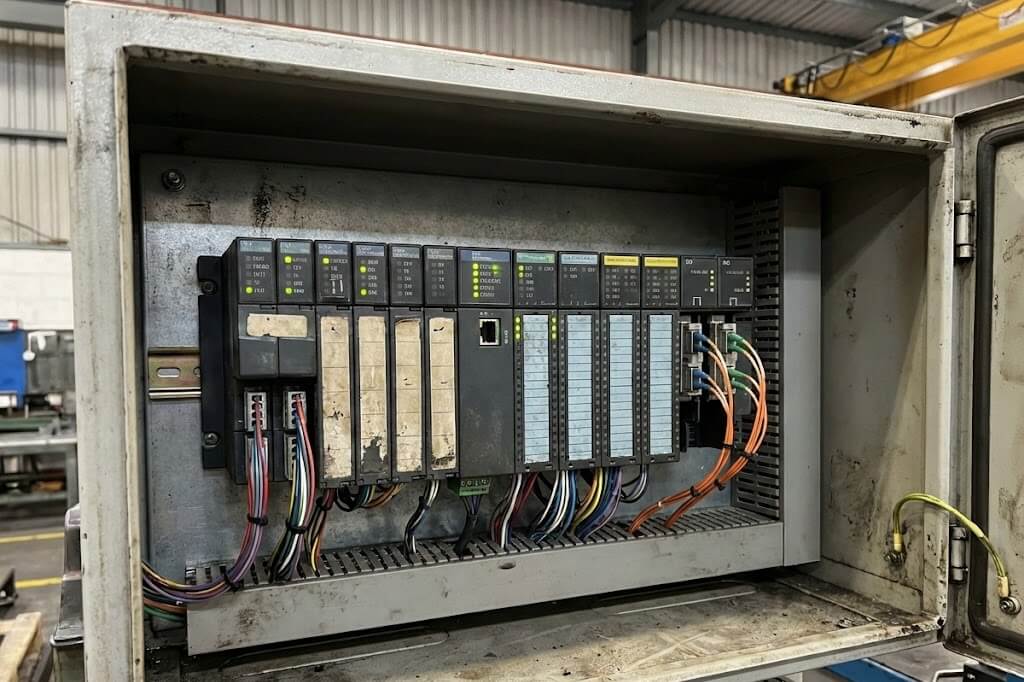
Programmable Logic Controllers (PLCs) controlling conveyors, packaging machines, and robotic arms.
Transportation Automation
Traffic lights adjusting according to real-time traffic flow.
Real-Life Example – Bottling Plant with PLC Control
Sensors detect empty bottles on a conveyor belt. A PLC ensures each bottle is filled, capped, and labeled perfectly—without human contact.
The Four Types of Automation
Automation can be categorized into four main types:
Fixed Automation
-
Definition: Specialized machines performing a single task.
-
Example: Welding the same car part on an automotive assembly line.
-
Best For: High-volume, repetitive production.
Programmable Automation
-
Definition: Machines and systems that can be reprogrammed for new tasks.
-
Example: Adjusting a packaging machine using PLCs for different product sizes.
-
Best For: Medium-volume production with periodic changes.
Flexible (Soft) Automation
-
Definition: Systems that respond to input changes with minimal downtime.
-
Example: Robotic arms in electronics assembly switching between products seamlessly.
-
Best For: Small batches with frequent design variations.
Integrated Automation
-
Definition: Fully connected systems of hardware, software, and data operating autonomously.
-
Example: Smart factories integrating machines, sensors, and ERP software in real time.
-
Best For: Highly digital, data-driven production environments.
Three Basic Elements of Any Automation System
Every automation system—whether for a home coffee maker or an industrial machine—has three essential components:
Input Devices
Sensors, switches, or user interfaces providing data to the system.
-
Example: Temperature sensors in heating systems.
Processing Unit
Logic controllers that analyze inputs and decide outputs.
-
Example: A PLC determining when to turn a motor on or off.
Output Devices
Actuators, motors, lights, alarms—components that execute the action.
-
Example: A robotic arm placing a product into packaging.
Four Essential Elements of Automation Explained
Some engineers prefer to add a fourth element for a complete view:
Power Source
Provides energy for the system to operate.
Command System
The programmed logic controlling actions.
Feedback System
Sensors or monitors providing performance visibility and error detection.
Actuators
The mechanical parts performing physical tasks.
Without feedback systems, automation would be “blind,” unable to detect and correct errors.
Common Automation Tools and Software
Automation systems are implemented using a variety of tools:
PLC Programming Software
Examples: Siemens TIA Portal, Allen-Bradley Studio 5000, Omron CX-Programmer.
SCADA Systems
Supervisory Control and Data Acquisition platforms for large-scale monitoring.
Robotic Controllers
Control the precise motion of industrial robots.
Industrial IoT Platforms
Enable remote monitoring and predictive maintenance.
Simulation Software
Tools like Factory I/O allow testing logic before deployment.
Why Does Automation Matter in Today's World?
Benefits for Organizations
-
Lower operational costs
-
Higher productivity and throughput
-
Improved quality control
-
Better worker safety
Career Advantages for Individuals
Skills like PLC programming and automation system design are in high demand, offering career stability and growth opportunities.
Next Steps – Getting the Correct Hardware for Automation
Whether you’re learning automation or already working in industry, having the right equipment is crucial.
Global Brands for PLC and Automation Components
At TopAutoDevice, we offer industrial-grade PLCs and automation components from trusted manufacturers:
Explore TopAutoDevice PLC and Automation Products
Whether starting your first project or upgrading an entire production line, our team provides expert guidance and top-quality products.
👉 Browse our PLC and Automation Products at TopAutoDevice.